- Season 3 Trailer
- Fake Booze
- English Wine: Now What?
- How to Buy Wine
- Bordeaux’s White Bank
- We’re Making Wine for Hope & Glory
- WTAF – Wine’s Alt Format Warriors
- The Oz Clarke EXCLUSIVE!
- Our Wines of the Year
- A Drink to Dry
- Coffee Dorks Meet Wine Nerds
- Burgundy 2020 Brief
- Getting to know the Côtes de Bordeaux
- The New Champagne
- The Magical Science of Taste
- Boxing Clever?
- Georgia 4 Ukraine
- On Natural Wine
- Fake Booze 2
- Adventures in Dosage
- Tasting 1982 Bordeaux
- Armenia’s Ambition
- The World’s BIGGEST Wine Competition
- Wine from the Arab World
- Why Bother Matching Food and Wine?
- Wine 4 Curry
- Wine 4 Roast Lamb
The above is a short taster of the full episode, which is now part of the Wine Blast archive. Wine Blast PLUS subscribers have exclusive access to the full archive as well as bonus content, early episode access and other benefits. To find out more or sign up, visit Wine Blast PLUS.
Summary
Did you know that just changing the light and music can alter how you perceive a wine by up to 20%? Ever wondered why that bottle of holiday rosé was such a crushing disappointment when you got it home?
High-tempo music can make a dish taste more spicy – lower-pitch sounds bring out bitterness in wine. (Though, ‘we can’t turn water into wine musically…yet.’) Rubbing velvet versus sandpaper can change how you perceive a wine’s body. Even the microbiomes in our gut and mouth can affect our perception of a wine.
Welcome to the curious world of Professor Charles Spence – experimental psychologist and one of the world’s foremost experts in multisensory perception. He follows on from what the Italian Futurists pioneered in the 1930s (and they, according to Spence, ‘recommended turning up to dinner parties in pyjamas made from satin, silk, velvet and sandpaper, and eating the food without cutlery by burying your face in the plate while rubbing your neighbour’s jim-jams…’)
This is the first in a series of programmes we’ll be doing on wine and food. Before we launch into the delicious nitty-gritty, we wanted to understand the world of taste and flavour in more depth. So here we dive into the world of smell, sound, touch, sight, taste, atmosphere, glassware, bottles, genetics – and the future.
In the mix are hyper-directional speakers and sound showers, ‘spit-in-bag’ dinners, parosmia, artificial reality and drinking liquid gold.
What Spence finds ‘intriguing’ are, ‘ those potentially transformative or magical experiences that you might get by combining wine with food or music.’
This is our kind of science – and this fascinating episode serves as the perfect launch-pad to leap into the delicious world of food and wine. Bon appetit!
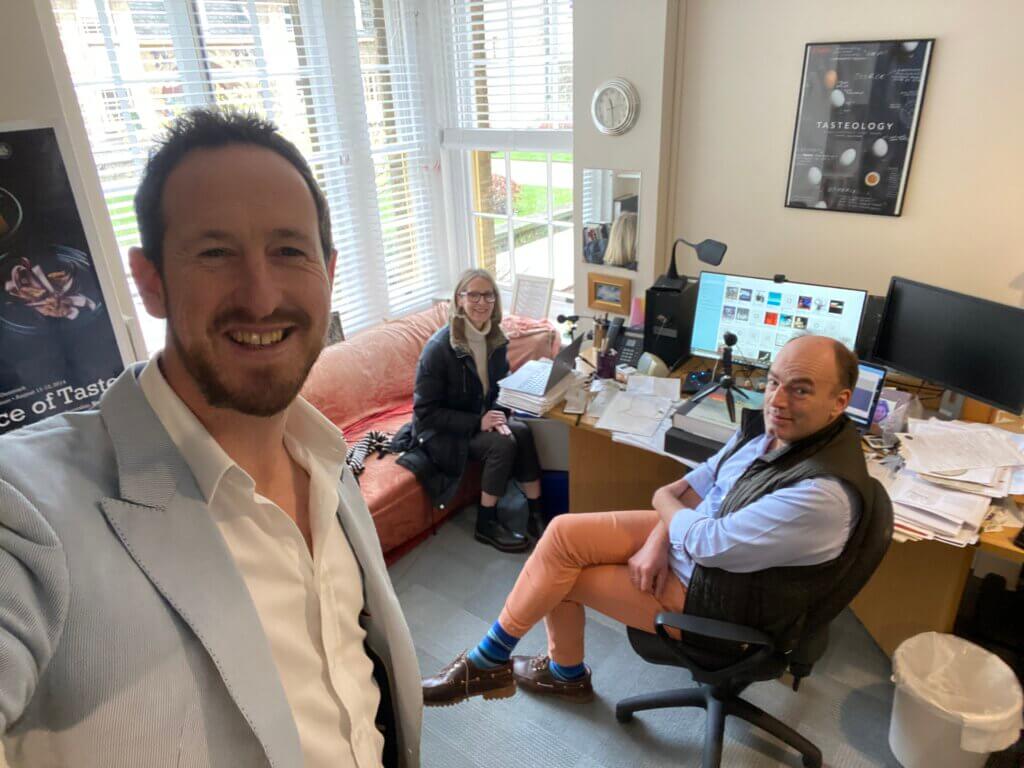
Starring
Books
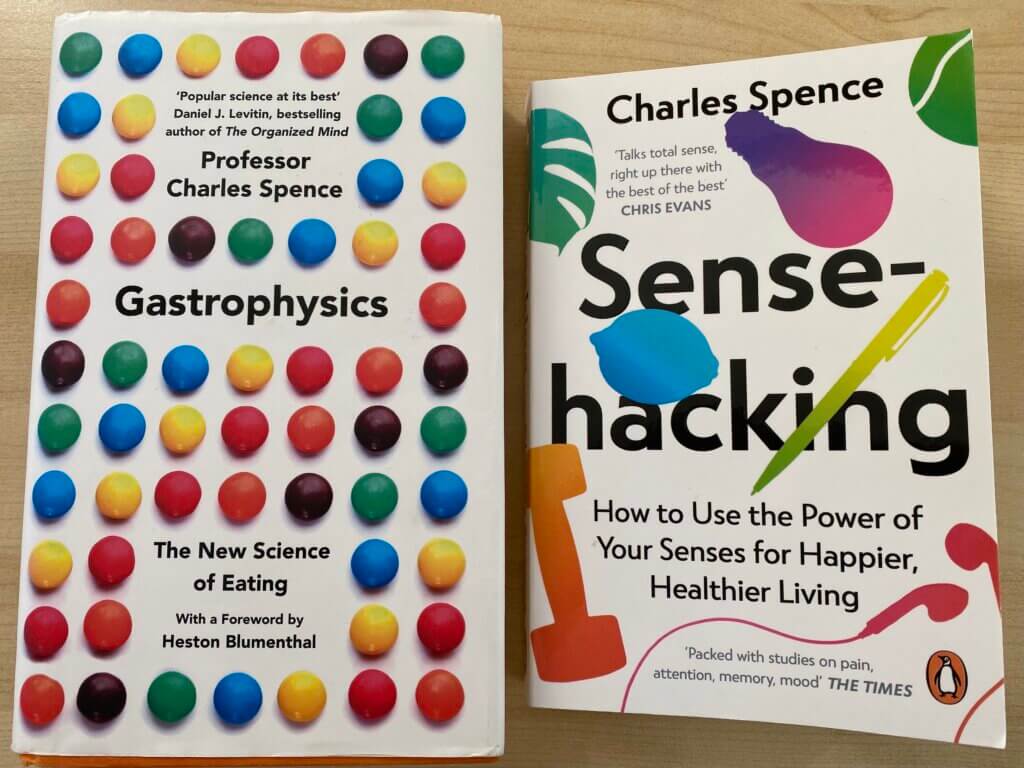
- Gastrophysics: The New Science of Eating
- Sense-hacking: How to Use the Power of Your Senses for Happier, Healthier Living
Transcript
This is a transcript of the short taster episode. It’s AI generated, so not perfect.
Peter Richards MW 0:00
Hello, this is a short taster of an archive episode of Wine Blast. The full episode is available for Wine Blast PLUS subscribers. To sign up, just head to wineblast.co.uk or click the link in the show notes.
Peter Richards MW
Hello and welcome to Wine Blast with me, Peter Richards, and my wife and fellow master of wine, Susie Barrie. And in this one, we’re going on a fun and fascinating foray into the realms of science, psychology, and sandpaper…
Susie Barrie MW 0:36
Yes, prepare to have your mind boggled because we are privileged to have been granted an audience with the brilliant and really quite famous Professor Charles Spence, an experimental psychologist and world expert in multi-sensory perception and experience design. His work tends to blow your mind before reassembling it in unexpected and exciting ways. And we think every wine lover needs to be aware of this stuff.
Prof Charles Spence 1:03
The pleasures of the table really reside in the mind, not in the mouth. I mean, I guess the protocol for wine tasting is multi-sensory. We are all influenced by the environment, and knowing that, one thinks, well, okay, how can we then optimise the environment or the atmosphere? And it is those sort of potentially transformative or magical experiences that you might get by combining wine with food or wine with music that are really intriguing.
Peter Richards MW 1:28
So, how we experience the world around us and how we can get the most out of our wine. Those are things we’re all interested in, yeah?
Susie Barrie MW 1:35
We are. We are indeed.
Peter Richards MW 1:36
Okay, good. So we’re going to touch on taste, smell, sight, sound, touch, atmosphere or setting, glassware, bottles, genetics, um, and the future. Um, how am I doing there?
Susie Barrie MW 1:50
Uh there’s a lot of touching.
Peter Richards MW 1:51
It’s a lot of stuff. We’re touching a lot of stuff. Including touch. Stop it. Touch and touch. Um, I had to say that editing this conversation down to an acceptable length was a huge challenge. I mean, it’s every week, but particularly this week, because it was the conversation was just so far-reaching and fascinating, wasn’t it? You know, he’s the kind of guy you just want to keep asking questions on.
Susie Barrie MW 2:11
Yeah, I mean, you I think you had to drag me away from in the end, didn’t you? Um otherwise he’d have probably slapped us with a restraining order. Another one. Anyway, um, anyway, the reason that we are looking into the science of taste isn’t just a bit random. This is part of a plan. Do we have a plan? I think we’ve got a plan. We’ve got a plan today. We’ve got a plan. We’ve got a plan. We’ve got a plan to devote a series of programmes to food and wine. Or wine and food. That’s our plan. I mean, it’s a subject we’ve done a lot of work and research on over the years. Um, it is pooh-poohed by some experts, but we think it is fascinating and instructive and helpful, and it’s also fun. Fun is the most important thing, isn’t it?
Peter Richards MW 2:47
What was it? I mean, what was it, Jean-Baptiste Lecaillon said in our last episode? It was like enjoying a good food and wine match brought him to a higher level of happiness. Yeah.
Susie Barrie MW 2:55
And if you think about it in terms of happiness, that’s absolutely the right approach, isn’t it? After all, the man who makes Cristal cannot be wrong.
Peter Richards MW 3:04
He can’t be wrong.
Susie Barrie MW 3:05
He can’t be wrong. Anyway, there’s lots to learn and to share. So we’ll be doing a number of programmes on this theme in different ways over the coming months.
Peter Richards MW 3:12
Yeah, but we wanted to start at the beginning, didn’t we? Uh, which is, you know, in this context, understanding how we taste and experience food and wine in the first place. Because, you know, a lot of what we think we know about this isn’t quite right. Is that fair to say?
Susie Barrie MW 3:26
A lot of things we, you and me, yes, yes, and everyone.
Peter Richards MW 3:30
We as wine experts, but everyone out there, I think we all can be surprised because we don’t know the stuff. You know, and it’s I think it’s just worth being aware of before we dive further in. So, drinking liquid gold in satin and sandpaper pyjamas, you know, with Mozart and just the right kind of glasses and food. I think I know what we’re doing for our next dinner party. Do you know? Yeah. Anyone who’s invited, just beware.
Susie Barrie MW 4:00
It does it does make you think, doesn’t it though? Um, or rethink the way you approach your wine and food and everything else that goes on around it.
Peter Richards MW 4:08
Yeah, the everything else that goes on around it, isn’t it? It’s fascinating. And of course, at the heart of it all is how we all live in different taste worlds, you know, partly due to our genetic makeup, you know, the number of taste buds we have on our tongue, the specific anosmias or things we can’t smell, but also, you know, the differences in experience, emotions, you know, even the makeup of our gut microbiome.
Susie Barrie MW 4:26
I mean, that’s interesting, isn’t it? Intriguing. Yeah, it is intriguing. That research about how the microbes in our mouth can change what aromatics are released from any given wine. And that’s obviously different for different people.
Peter Richards MW 4:38
It is you know, so the microbiome of not just the vineyard and the wine, which is fascinating and poorly understood itself, but also the microbiome of people, not just in the gut, but in in your mouth and and elsewhere. You know, I I think it’s absolutely fascinating, and it would be so good to know more about it.
Susie Barrie MW 4:54
And we did also chat briefly about COVID. Um and Charles said he’d been surprised at how the clear evidence it was affecting people’s taste and smell hadn’t been picked upon earlier, and that it would have been very different if people had been going blind.
Peter Richards MW 5:07
Which is sorry, doesn’t it?
Susie Barrie MW 5:09
It’s a bit harsh, but fair enough. I mean, what he added, he added that what’s called parosmia has also been common. So when things smell different to how they used to smell, so he talked about it.
Peter Richards MW 5:20
So anosmia is not smelling, whereas parosmia is just smelling things differently.
Susie Barrie MW 5:26
He talked about a chef, for example, who who used to love coffee, but now it smelled for him like London buses or diesel. You know, that that’s sort of really not good.
Peter Richards MW 5:37
Goodness me. So wine tasting as an experience. That’s the way we’re gonna launch into our food and wine theme over programmes to come, armed with all this fascinating knowledge and awareness, courtesy of Professor Charles Spence. So thank you, Charles.
Susie Barrie MW 5:51
Absolutely, absolutely. We’re very grateful to Charles for his time and fascinating insights to this intriguing subject. If you want to learn more, do buy his books. We’ll put a link in our show notes to those. Thanks to everyone again for joining in our Bordeaux competition. We’ll be back very soon. Thanks for listening and cheers!